Travel order (kiküldetési rendelvény) in Hungary 2026: what to fill in, what is tax-free, Excel template
· 6 min read
What goes on a Hungarian travel order, how much a company can pay tax-free for the use of your own car, and when it cannot be used – with a 2026 worked example, a self-calculating Excel template and a calculator.
The travel order (kiküldetési rendelvény) is the document a Hungarian company uses to reimburse you for using your own car on its business. If the reimbursement is no more than the fuel by the consumption norm at NAV’s monthly price plus HUF 15/km, it does not count as income and no company car tax arises. It must show your name, your tax ID, the car’s details, the purpose, time and route of the trips, the distance, and how the reimbursement was calculated.
This article is for information only, not tax advice: it is based on the Hungarian Personal Income Tax Act (Szja tv.) and NAV’s 2026 information booklet 08 (as of 20 November 2026). Always agree the accounting with your accountant.
What is a travel order?
Under § 3 point 83 of the Szja tv., it is a document issued by the payer in two copies about the business trips an individual made with their own car. The original stays with the payer, the copy with the individual, and both are kept under the document retention rules. It can be electronic: an electronically produced document handled and stored in a closed system, in line with the digital archiving rules, also counts as a travel order.
It is not limited to employment: according to NAV it can also be issued under an agency contract, to members, executive officers or elected officials – even if the individual is not paid for their work and only asks for the cost of using the car.
What must it contain?
| Field | Example |
|---|---|
| Name and tax ID of the individual | Anna Kovács, a 10-digit number starting with 8 |
| Make and model of the vehicle (as registered) | Škoda Octavia 1.6 |
| Registration number | ABC-123 |
| Purpose of the trip (whom, on what business) | client meeting, Fenyő Kft., Nyíregyháza |
| Duration of the trip (date, departure, arrival) | 4 Nov 2026, 8:10–13:40 |
| Route (from, to, back) | Debrecen – Nyíregyháza – Debrecen |
| Distance driven | 100 km |
| Reimbursement and its data (norm, price, amount) | 9.5 l/100 km, HUF 639/l, HUF 7,571 |
The example data are made up. The payer’s (company’s) details are not on the statutory list, but it is worth showing them on the document; the downloadable template has fields for them.
How to fill it in, step by step
- Header: the company’s name, address and tax number; the individual’s name and tax ID; the car’s make, model, registration number, engine size and drive.
- Norm: the consumption norm for the car, usually the standard allowance of Government Decree 60/1992 (9.5 l/100 km for a 1.6-litre petrol car). The table is in our article on consumption norms.
- Fuel price: the price NAV published for the month of the trip. If you deduct the VAT on fuel, you cannot use it – only the invoice price.
- Trips: one line each with the date, departure and arrival time, route, purpose and distance. One travel order can hold several trips – the Act lists the data of the “trip(s)” – so a monthly summary travel order is possible too.
- Calculation: km × norm / 100 × NAV price for the fuel, plus km × HUF 15 standard cost, and the sum of the two.
- Signatures, two copies: the payer and the individual sign; the original goes to the company, the copy to the individual.
How much can be paid?
You drive 240 km in November on three business trips in your own 1,600 cc petrol car:
- Fuel: 240 km × 9.5 l/100 km = 22.8 litres × HUF 639 (NAV, November 2026) = HUF 14,569.
- Standard cost: 240 km × HUF 15 = HUF 3,600.
- Tax-free reimbursement: HUF 18,169.
For another car or month, our mileage allowance calculator works it out instantly. If the company pays more, the whole amount is taxable income – not just the difference. The individual can then choose: claim the amount allowed without receipts as a cost, or account for costs from a mileage log and invoices; the latter also means paying company car tax (NAV booklet 08, point 3.1.2).
When can it not be used?
- For a car that is not yours. The favourable rule applies to a passenger car you or a close relative own; it does not apply to company or rented cars (NAV booklet 08, point 3.2).
- For goods vehicles the HUF 15/km standard cost does not apply; costs can be reimbursed on the basis of a mileage log.
- For commuting. The trip between home and work is not a business trip; at most HUF 30/km can be paid tax-free for it, with no fuel on top.
- Twice for the same trip. A trip reimbursed on a travel order cannot also go into the mileage log as a business trip.
The daily allowance (napidíj) is a separate matter with its own rules and tax treatment; this article only covers reimbursement for the use of the car.
As a sole trader
For your own business’s trips you keep a mileage log or choose the 500 km monthly flat rate. You can receive a travel order in another capacity, for example from a company you are a member or agent of. According to NAV, you don’t enter those trips in your own mileage log, and they count as private trips when you apportion costs (NAV booklet 08, point 5.2).
Travel order or mileage log?
On a travel order the reimbursement – up to the amount above – is tax-free and no company car tax arises. According to NAV, a mileage log is typical when someone uses their own car for business regularly: the reimbursement is then taxable income against which the costs can be claimed, and company car tax is due. The comparison and the numbers are in our mileage allowance article, the mandatory content and an Excel template in our mileage log article.
Downloadable template
Travel order template 2026 (Excel) – you fill in the yellow cells, the template does the rest:
- the norm from the engine size and the drive (petrol, diesel, LPG, CNG, plug-in hybrid, electric),
- the NAV price from the month (the 2026 prices on a separate sheet; if a month’s price is not there yet, you enter it by hand),
- per line the fuel cost, the HUF 15/km and the reimbursement, with totals and room for signatures at the bottom.
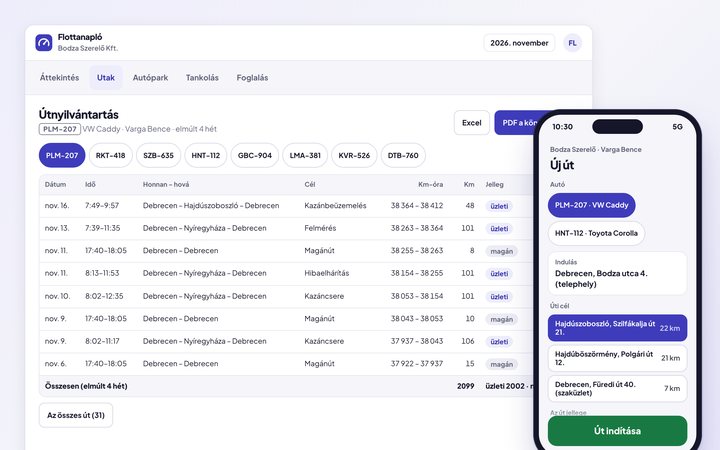
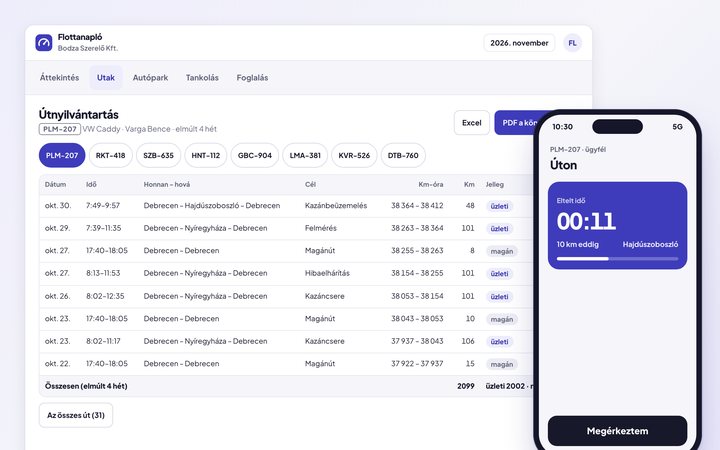
If you need to collect the trips of several cars and drivers every month, Flottanapló, a digital trip log, helps: drivers record trips on their phone, and at month end you get a finished mileage log and report per car for your accountant.
Frequently asked questions
- What must a Hungarian travel order contain?
- The individual’s name and tax ID; the vehicle’s make, model and registration number; the purpose, duration and route of the trip(s); the distance; the reimbursement and the data needed to calculate it (norm, fuel price) – Szja tv. § 3 point 83.
- How much can be paid tax-free on a travel order in 2026?
- For your own car, the fuel by the consumption norm at NAV’s monthly price, plus HUF 15/km. For a 1.6-litre petrol car in November 2026 this is HUF 75.7/km.
- Can one travel order cover several trips?
- Yes: the Act lists the data of the trip(s), so one travel order can include several trips, even all trips of a month, each with its own date, route and distance.
- Can a travel order be electronic?
- Yes, if it is an electronically produced document handled and stored in a closed system that meets the digital archiving rules (Szja tv. § 3 point 83).
- Can it be used for a company car?
- Not the favourable, tax-free rule: that only applies to a passenger car owned by you or a close relative.
- What if the company pays more than the calculated amount?
- Then the whole amount is taxable income, not just the difference. The individual can then choose how to claim costs against it.
Sources
- Act CXVII of 1995 (Szja tv.): § 3 point 83 (travel order), § 7 (1) r), Annex 3, II. 6 and IV. 3 (in Hungarian) – retrieved 20 November 2026
- NAV information booklet 08: Accounting for vehicle operating costs (30 January 2026, in Hungarian), points 3.1.2, 3.2, 4 and 5.2 – retrieved 20 November 2026
- Government Decree 60/1992 (IV. 1.), § 4 – the standard allowance (in Hungarian)
- NAV: fuel prices applicable in 2026 (in Hungarian) – retrieved 20 November 2026
Found it useful? Pass it on to someone it could help.