The 500 km flat rate for sole traders in Hungary 2026: what can you claim without a mileage log?
· 5 min read
A Hungarian sole trader can claim 500 km a month instead of keeping a mileage log. When it pays off, what else you can claim, what to watch out for – with a 2026 worked example and legal references.
A Hungarian sole trader (egyéni vállalkozó) can claim 500 km a month for the use of their own car without keeping a mileage log, regardless of the number of cars, for the whole tax year. Fuel is then claimed according to the consumption norm and NAV's monthly price, upkeep only at the HUF 15/km standard cost – but no company car tax is due (Szja tv. – Personal Income Tax Act – Annex 11, III. 11). For a 1.6-litre petrol car that is about HUF 37,900 of cost a month in November 2026.
This article is for information only, not tax advice: it is based on the laws in force and NAV's 2026 information booklets (as of 14 November 2026). Decide with your accountant which method is better for you.
Who is it for?
For sole traders who pay tax with itemised cost accounting (entrepreneurial personal income tax) and also use their car in the business. The same rule applies to primary agricultural producers (Szja tv. Annex 3, IV. 8).
Flat-rate taxpayers (átalányadózó) and KATA taxpayers have no itemised cost accounting – according to NAV, company car tax therefore doesn't apply to their cars either – so the 500 km flat rate doesn't come into play for them.
What can you claim?
- Fuel: 500 km × the consumption norm × NAV's fuel price for that month.
- Upkeep, repairs: only the general car standard cost, HUF 15/km – HUF 7,500 a month (Szja tv. Annex 11, III. 6).
- No mileage log is needed, and no company car tax is due (NAV booklets 08 and 31).
The flat rate is 500 km a month however many cars you use: two cars still don't make 1,000 km. The choice applies to the whole tax year (or, if you started the business during the year, its whole duration); you cannot switch back to an itemised mileage log during the year. NAV's booklet refers to the use of your own car – for a leased or rented car, ask your accountant.
Worked example for November 2026
1,600 cc petrol car, NAV's November price HUF 639/litre:
- Fuel: 500 km × 9.5 litres/100 km = 47.5 litres × HUF 639 = HUF 30,353.
- Standard cost: 500 km × HUF 15 = HUF 7,500.
- Claimable per month: HUF 37,853.
For a diesel car (1,501–2,000 cc, 6.7 litres/100 km, HUF 712/l): 33.5 litres × HUF 712 = HUF 23,852 + HUF 7,500 = HUF 31,352. The amount changes each month, because the NAV price changes too.
When does it pay off – and when not?
- It pays off if you use the car little for the business and don't want to log every trip: for the 500 km you don't have to prove where you went.
- It doesn't pay off if you have far more business trips a month: with an itemised mileage log, every proven business kilometre can be claimed – but then company car tax is due, and the log must be complete.
The difference between the two varies by car and by year. It's worth working it out with your accountant for an average month before you decide at the start of the year.
If you'd rather keep a mileage log
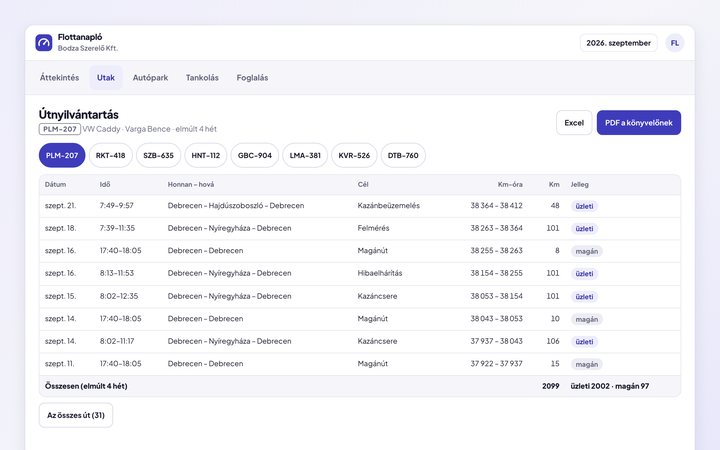
For itemised claims you need, for each car, the date, purpose, business partner visited and distance of every business trip, with the odometer reading at the start and end of the year. The full list and a downloadable Excel template are in our mileage log article; the HUF 15/km and travel-order rules are in mileage allowance 2026.
If you'd rather not keep the log on paper or in Excel, the Flottanapló digital trip log turns trips recorded on a phone into a finished log for your accountant at the end of the month.
Frequently asked questions
- How much can you claim with the 500 km flat rate in 2026?
- Fuel according to the consumption norm and NAV's monthly price, plus the HUF 15/km standard cost. For a 1.6-litre petrol car in November 2026 that is about HUF 37,900 a month.
- Do I need a mileage log for the 500 km flat rate?
- No: that's the whole point. A sole trader can claim the 500 km a month instead of keeping a mileage log.
- Do two cars mean 1,000 km?
- No: the 500 km a month is independent of the number of cars.
- Is company car tax due with the 500 km flat rate?
- According to NAV, no: there is no itemised cost accounting in this case, so no company car tax arises.
- Can a flat-rate taxpayer claim the 500 km?
- No: a flat-rate taxpayer has no itemised cost accounting; the flat-rate cost ratio covers their costs.
- Can I switch during the year?
- No: the 500 km flat rate can be chosen for the whole tax year – or, for a business started during the year, for its whole duration.
Sources
- Act CXVII of 1995 (Szja tv.): Annex 11, III. 6, III. 9 and III. 11, Annex 3, IV. 3 and IV. 8 – retrieved 14 November 2026.
- NAV information booklet 08: Accounting for vehicle operating costs (30 January 2026) and booklet 31: Company car tax and related personal income tax rules (22 January 2026), both in Hungarian – retrieved 14 November 2026.
- Government Decree 60/1992 (IV. 1.) and NAV: fuel prices applicable in 2026 – retrieved 14 November 2026.
Found it useful? Pass it on to someone it could help.