GPS tracking in company cars: what may an employer do in Hungary?
· 6 min read
Can you track company cars by GPS? When Hungary's Labour Code, the GDPR and the data protection authority NAIH allow it, and how it differs from a mileage log.
GPS trackers are cheap today, and many managers think: the car belongs to the company, so the company may know where it is. The car does belong to the company, but the location data is also about the driver: it shows when they were where, for how long, and where they stopped. That makes GPS tracking a form of employee monitoring, and it has rules.
What the Labour Code says
Under section 11/A (1) of the Hungarian Labour Code (Mt.), an employee may be monitored in connection with their conduct related to the employment; the employer may use technical means for this, but must inform the employee in writing in advance. Section 9 (2) adds that an employee's personality rights may only be restricted if this is strictly necessary for a reason directly related to the purpose of the employment and proportionate to the aim.
Two things follow. Private life outside working hours is not the employer's business, and the monitoring may not go further than its purpose justifies.
What the GDPR says
Location data is personal data, so tracking is data processing. Employers usually rely on legitimate interest (GDPR Article 6 (1) (f)). That requires a balancing test: you have to write down the purpose, why it cannot be achieved with a less intrusive tool, and why the harm to the employee does not outweigh the company's interest. Employees must be informed (Article 13), only data necessary for the purpose may be collected (Article 5 (1) (c)), and employees can object to processing based on legitimate interest (Article 21).
Consent is generally not a good basis: according to the EU data protection authorities' opinion cited below, because of the dependency in an employment relationship, consent can only be a valid legal basis in exceptional cases – an employee finds it hard to say no to their employer.
The position of NAIH
NAIH, the Hungarian National Authority for Data Protection and Freedom of Information, put it the same way in its guide on workplace data processing and in a 2013 statement: it recommends GPS for logistics, to determine the position of the vehicle, not to follow the employee.
According to the guide, acceptable purposes include:
- work organisation, when the company needs to know where a courier or a haulier is at a given moment;
- the value of the load or the vehicle itself (large amounts of cash, valuable goods, dangerous goods);
- the safety of the employee, for example on a dangerous route.
Two of its sentences matter most for a small company. Monitoring may only take place during working hours; an employee's location may not be checked outside them. And if the employee may keep the car outside working hours, they must be able to switch the GPS off. In a 2013 case NAIH also stated that where a car does not carry anything of significant value, GPS is not justified for asset protection, and it called on the company to stop non-logistics tracking.
The 2017 opinion on data processing at work by the Article 29 Working Party (the joint body of EU data protection authorities at the time) reaches the same conclusion: where private use of a company car is allowed, the employee should in principle be able to temporarily switch off location tracking, and there is unlikely to be a legal basis for tracking outside agreed working hours. Quoting an earlier opinion, it says vehicle tracking devices are not staff tracking devices.
Continuous tracking or a mileage log?
The two are often confused, but they are about different things.
| Continuous GPS tracking | Mileage log | |
|---|---|---|
| What does it record? | the exact location, minute by minute | per trip: when, from where to where, whom, how many km |
| Why is it needed? | work organisation, asset protection | for tax and for accounting for costs |
| When does it run? | however you set it – which is why it must be limited | only during the trip, started and ended by the driver |
| How intrusive is it? | very | slightly |
The content of the mileage log is set by Annex 5 of the Hungarian Personal Income Tax Act, and it needs no continuous location data. The distance can come from the odometer or a route planner. If a company is thinking about GPS only to have a mileage log, recording that the driver starts themselves is the more proportionate choice.
If you do need GPS: a small company checklist
Say a landscaping company in Győr with 6 cars wants to see its vehicles because crews have to be redirected between sites during the day. That is a work organisation purpose, so it can be a legitimate interest. The order:
- Write down the purpose in a sentence or two, and why phone calls are not enough.
- Carry out the balancing test and record it in writing.
- Limit it to working hours; if the car goes home, tracking should stop in the evening and at weekends, or the driver should be able to switch it off.
- Decide who may see the data (not everyone in the office), and how long you keep it.
- Give every driver a written notice before you start, with the purpose, access, retention period and their rights.
- Use the data only for what you introduced it for. If it turns into daily performance scoring, that is a different purpose.
How Flottanapló handles this
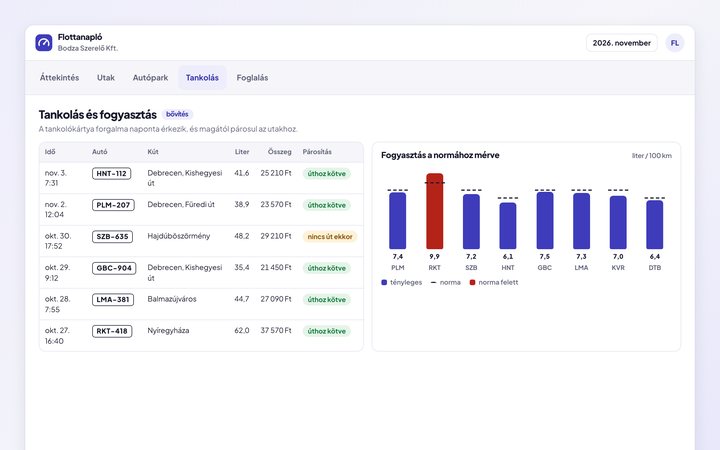
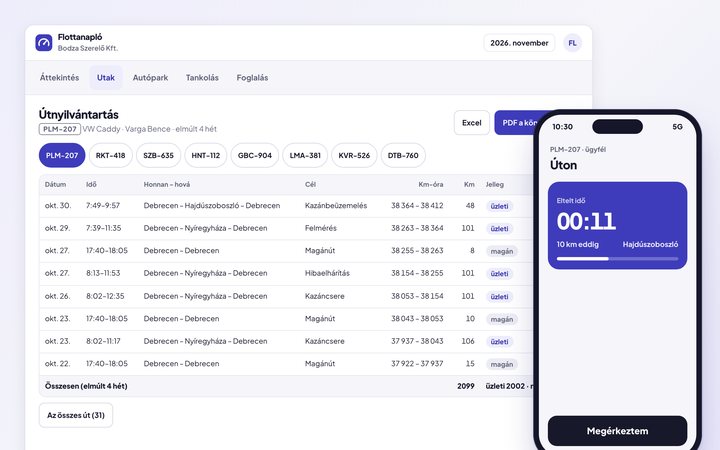
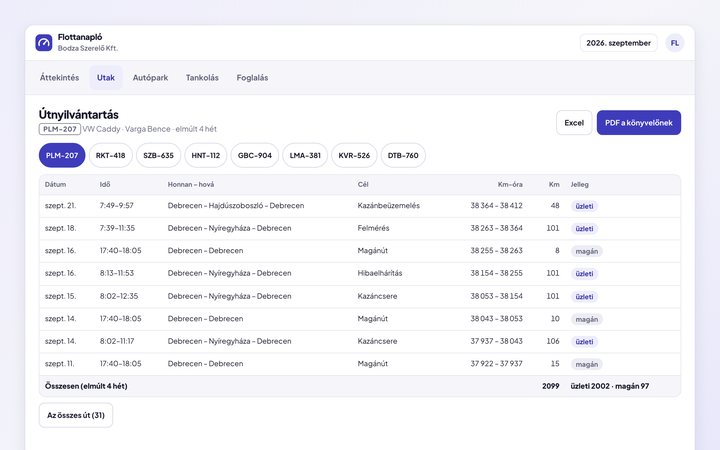
Flottanapló is a mileage log by default: drivers start and end trips on their phone, and the phone only measures distance during a trip. GPS comparison (detours, trips without a log) is a separate add-on, limited to working hours, switched on after staff have been informed.
General information based on the rules and authority positions known on 23 September 2026, not legal advice. Before introducing tracking, have a data protection professional review your balancing test.
Sources
- Act I of 2012 on the Labour Code, sections 9 (2) and 11/A (1) – in Hungarian
- Regulation (EU) 2016/679 (GDPR), Articles 5, 6, 13 and 21
- NAIH: guide on the basic requirements of workplace data processing (2016), point 5: GPS – in Hungarian
- NAIH statement on GPS fitted in vehicles (NAIH-42-6/2013/V) – in Hungarian
- Article 29 Working Party: Opinion 2/2017 on data processing at work (WP249), section 5.7
- Act CXVII of 1995 on Personal Income Tax, Annex 5, II. 7 – in Hungarian
Found it useful? Pass it on to someone it could help.