Suspicious refuelling? How to spot it in a small fleet
· 5 min read
Matching fuel card transactions to the mileage log in a small fleet: odometer, consumption, weekend refuels, oversized fills – and asking without accusing.
An electrical contractor in Szeged with 7 cars sees 60–70 refuels a month on its fuel cards. The manager flicks through the card statement, every line looks normal, and yet at the end of the month more has gone on fuel than the jobs done would justify. Misuse is rarely dramatic: more often a weekend refuel here, a few litres in the family car there, a jerrycan for the lawnmower.
You won't find this by reading the statement. You find it by comparing two sets of data: refuels against trips.
What you will need
- the fuel card transactions: time, station, litres, fuel type, registration or card number;
- the mileage log: date, time, from where to where, and the odometer reading for each trip;
- for each car, the tank capacity and a realistic consumption figure.
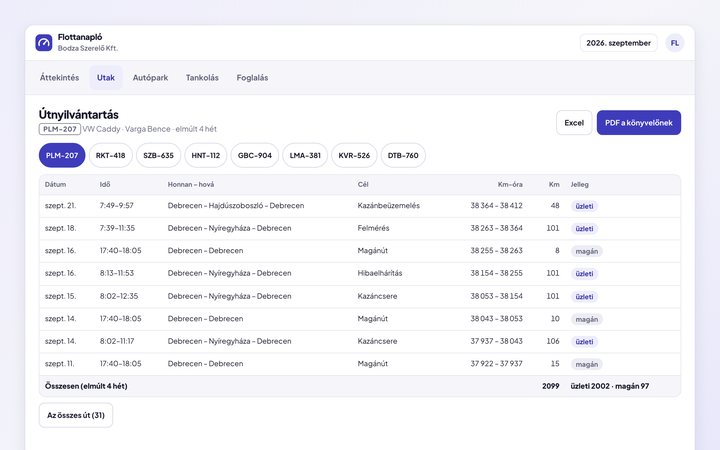
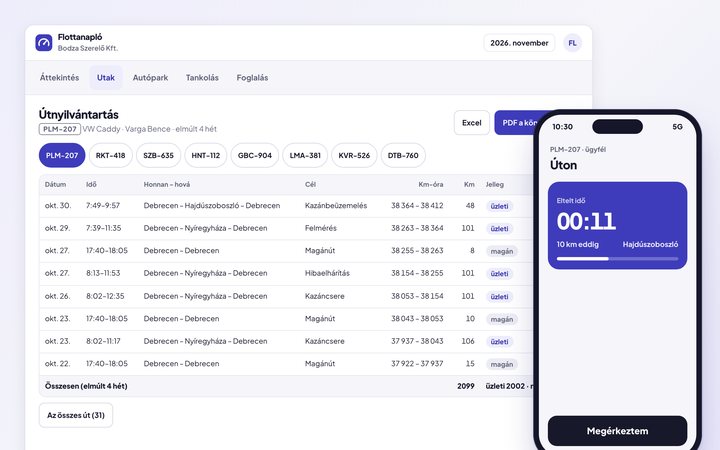
If the mileage log is still on paper, that is the first obstacle: nobody will regularly match 70 refuels against 300 trips by hand. The content of the mileage log is covered in a separate article.
Six signs worth watching
| Sign | What to check | Could also be innocent |
|---|---|---|
| Refuel with no trip | was a trip recorded at the time of the refuel or just before | the driver forgot to record the trip |
| Weekend or night refuel | was the car working that day | on-call duty, weekend job |
| More litres than the tank holds | litres > tank (e.g. 64 litres into a 50-litre tank) | a jerrycan for a work machine, if allowed |
| Two refuels close together | few km driven between them | an interrupted refuel, a faulty pump |
| Different fuel | petrol on a diesel car, premium fuel instead of the usual | a mistake, or the station only had that |
| Consumption above the car's average | litres / km driven between two full tanks | city traffic, a trailer, a winter month |
A single sign almost never proves anything. Several together – say, a Saturday refuel with no trip, followed by a jump in consumption the next Monday – are worth a question.
Odometer and consumption
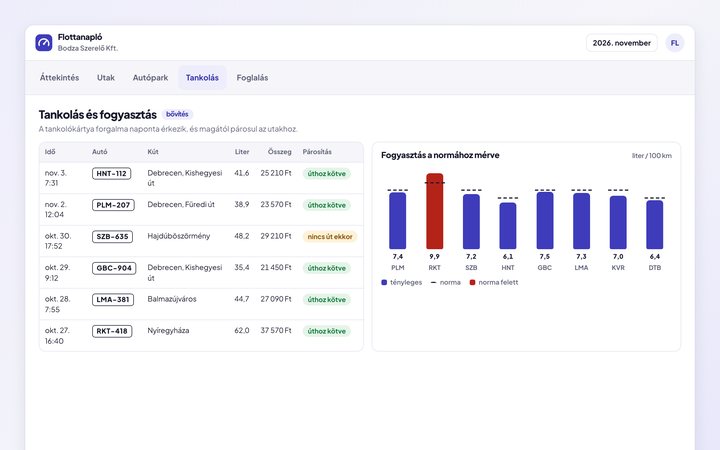
The most reliable test is consumption measured from full tank to full tank: the kilometres between the two refuels (from the mileage log) and the litres of the second refuel. If a car has used around 7 litres per 100 km for months, and one month comes out at 9.5 litres, take a look.
What to compare with? Best of all, the car's own average over several months. The legal norm serves a different purpose: Hungarian Government Decree 60/1992 sets the consumption that can be claimed without proof, for example 9.5 litres per 100 km for a 1,501–2,000 cc petrol car and 6.7 litres for a diesel of the same size. A modern car often uses less, so a value below the norm does not mean everything is fine – but a value above it is a signal.
On the odometer, check two things: whether the start reading of each trip matches the end reading of the previous one, and whether the reading recorded at the pump (if the card system asks for it) fits the trips. Missing kilometres may be an unrecorded private trip, which is a separate question from fuel, but it has to be cleared up just the same.
How to ask
Most discrepancies have an everyday cause, and a manager who accuses first can lose a good employee over a forgotten trip entry. A fair approach:
- Have the rule in place beforehand: put in writing what the fuel card may be used for (company car only, jerrycans only with permission, which fuel), and that refuels are compared with trips. Under the Hungarian Labour Code, employees must be informed in writing in advance about monitoring with technical means (section 11/A (1)).
- Ask, don't assert: “On Saturday at 14:20, 48 litres went into SZE-412, but there's no trip that day. What was it?” That is a fact and a question, not a verdict.
- Give a chance to fix it: if a trip wasn't recorded, the driver adds it; if it was a private refuel, settle it according to the rule.
- Write down the answer. If the same sign keeps coming back, next time you won't have to rely on memory.
- If serious suspicion remains, ask an employment lawyer about next steps before you say or do anything.
The other side: the economical driver
The comparison is not only about suspicion. If a driver consistently stays below the norm, the employer can pay the difference as a fuel saving to an employee who drives a company car as part of their job: under section 27 (1) (b) of the Hungarian Personal Income Tax Act, up to the amount of the saving and at most HUF 100,000 a month, this reduces the employee's tax base. For this, under section 5 of Decree 60/1992, the mileage log must also show the place, time and quantity of each refuel and the odometer reading. Agree the exact calculation with your accountant.
If you'd rather not do it by hand
Flottanapló flags a refuel that doesn't belong to any trip, and odometer readings that don't match between two trips; the driver fills it in, or you decide. As an add-on, it also brings in fuel card transactions and compares each car's consumption with the norm. You can try it with made-up data on the home page.
General information based on the rules in force on 4 November 2026, not legal or tax advice.
Sources
Found it useful? Pass it on to someone it could help.